

ITR brand rubber tracks were designed, engineered and manufactured using the most advanced technologies with the aim of providing an outstanding level of quality and durability for use on mini excavators, tracked skid-steer loaders and small dumpers. Years of experience, numerous field trials and design tests have contributed to the development of the continuous cable system currently used in all ITR brand rubber tracks. The continuous cable technology combines durability, flexibility and strength throughout the entire structure of the rubber track, reduces the level of wear and improves efficiency during operation.
The rubber structure complements and provides high protection for the cable system and the steel internal parts that form the load-bearing structure. The thick rubber layer absorbs impacts and protects the metal structure from shocks.
CHARACTERISTICS
- internal parts made of forged steel
- cables with greater thickness
- high resistance to scratches and wear
- reduced noise and vibration
- low ground pressure
- easy replacement for steel tracks
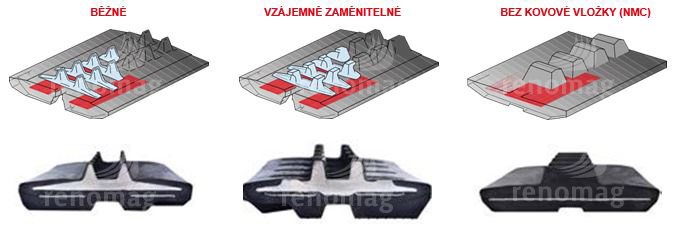
STANDARD TRACKS
Standard tracks can be used on track undercarriages designed to operate exclusively with rubber tracks. When standard tracks are used, the track rollers come into contact with the metal guides only to ensure guidance, preventing the track from coming off. This type of track undercarriage cannot work with steel chains.
INTERCHANGEABLE TRACKS
Interchangeable tracks can be used on undercarriages designed to operate with either rubber or, alternatively, steel tracks. When interchangeable tracks are used, the track rollers are in contact with the rubber track in the same way as with a steel chain.
TRACKS WITHOUT METAL CORE (NMC)
Tracks without a metal core contain no metal reinforcement and consist of a series of strong cables protected by a very thick rubber structure. The lightweight construction allows for greater track flexibility, while the large tread width provides higher traction without compromising surface grip.
ANTI-VIBRATION TRACKS (AV)
Anti-vibration tracks contain a metal core with an innovative guide shape designed to reduce vibration and the overall weight of the track, while guaranteeing the same durability and reliability. On anti-vibration tracks, the rollers move along an even path, which minimises vibration.
IDENTIFYING TRACK DIMENSIONS
Tracks can be identified based on three basic dimensions: track width, pitch and number of links.
You can rely on always receiving the correct size for your specific machine.

PITCH TYPES
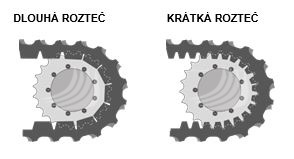
The most important dimension of a rubber track is the pitch. Pitch is the centre-to-centre distance between two consecutive metal cores. Based on pitch, tracks can be identified as long-pitch tracks (i.e. rubber tracks whose metal cores engage every two teeth of the drive sprocket) and short-pitch tracks (i.e. rubber tracks whose metal cores engage every tooth of the drive sprocket). These tracks are also known as Step short rubber tracks (or half-pitch tracks).
GUIDE TYPES
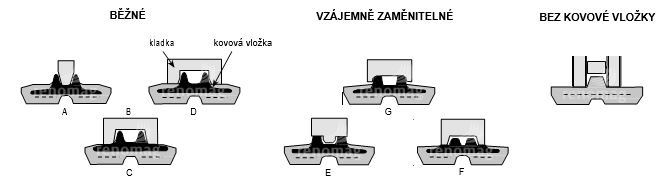
EXAMPLES OF ITR RUBBER TRACK GUIDE TYPE MARKINGS
| WIDTH | PITCH | GUIDANCE SYSTEM | SIZE (mm) | MAXIMUM MACHINE WEIGHT | |||||
|---|---|---|---|---|---|---|---|---|---|
| mm | mm | ||||||||
| - | 1 | 2 | 3 | 4 | 5 | 6 | kg | ||
| 150 | 72 | A | 65 | 46 | 39 | 23 | 23 | 21 | 500 |
| 180 | 60 | B | 61 | 54 | 32 | 25 | 20 | 22 | 500 |
| 180 | 72 | A | 70 | 51 | 38 | 24 | 29 | 30 | 700 |
| 180 | 72K | C | 64 | 53 | 40 | 21 | 22 | 20 | 700 |
| 190 | 72 | A | 68 | 50 | 38 | 21 | 28 | 27 | 800 |
| 200 | 72 | A-B | 76 | 56 | 40 | 23 | 28 | 26 | 1200 |
| 200 | 72K | C | 71 | 53 | 39 | 23 | 30 | 29 | 1200 |
| 230 | 72 | A | 82 | 57 | 40 | 24 | 30 | 26 | 1400 |
| 250 | 72 | A-B | 82 | 57 | 40 | 24 | 30 | 26 | 1600 |
| 320 | 84 | C | 96 | 82 | 60 | 46 | 48 | 34 | 4500 |


