
← Back to news
Anti-Vibration Rubber Tracks (AVT) ITR
Anti-vibration rubber tracks (AVT): when and why to use them?
Anti-vibration rubber tracks (AVT): when and why to use them?
Mechanical vibration is one of the underestimated risks facing both workers and machines on construction sites.
Earthmoving machines, such as mini excavators, are subject to considerable stress during operation, which can lead to damage to electrical components and electronic devices, loosening of bolts, or worsening of existing damage to sheet metal parts. All of this can also affect the health and safety of workers.
Risks arising from vibration and how to effectively guard against them?
In addition to discomfort, working without protective systems capable of dampening machine vibration can also cause physical harm, which can even lead to incapacity for work with permanent consequences.
According to occupational health and safety legislation, the following measures must be put in place to reduce the vibration to which the operator is exposed:
According to occupational health and safety legislation, the following measures must be put in place to reduce the vibration to which the operator is exposed:
- establish a regular machine maintenance plan with regard to securing the operator's seat and driving position
- identify which work tasks or machines expose the operator to strong vibration and, where possible, plan work shifts so that workers are exposed to these effects as little as possible
- purchase machines with low vibration levels
Modern machines are equipped with sophisticated mechanical and electronic compensation systems that raise operator comfort and safety to a high level. A significant undercarriage-component innovation has also been developed for earthmoving machines, particularly mini excavators, which can be considered an excellent ally in the fight against vibration: anti-vibration rubber tracks.
What is the difference between anti-vibration rubber tracks and conventional rubber tracks, and what are their advantages?
Compared to standard rubber tracks, which perform better on smooth, soft surfaces, anti-vibration rubber tracks are particularly suited to work on flat, hard surfaces such as asphalt, gravel, concrete and paving stones. This makes them ideal for mini excavators in the weight class up to 9 tonnes, which are widely used for urban maintenance and public works – small excavations, flower bed renovations, or cleaning of roads and ditches.
The main difference between rubber tracks and anti-vibration rubber tracks (AVT) lies in the special shape of the metal insert in the tread. A concrete example can be found in the "diamond shape" technology used by manufacturer ITR USCO – it features a diamond pattern and perfect guidance for the track rollers, thanks to which the roller's path becomes smooth, regular and continuous, resulting in vibration reduction of up to 75%. This technology reduces noise in the cab and the pressure the machine exerts on the ground, leading to increased traction and better stability.
The main difference between rubber tracks and anti-vibration rubber tracks (AVT) lies in the special shape of the metal insert in the tread. A concrete example can be found in the "diamond shape" technology used by manufacturer ITR USCO – it features a diamond pattern and perfect guidance for the track rollers, thanks to which the roller's path becomes smooth, regular and continuous, resulting in vibration reduction of up to 75%. This technology reduces noise in the cab and the pressure the machine exerts on the ground, leading to increased traction and better stability.
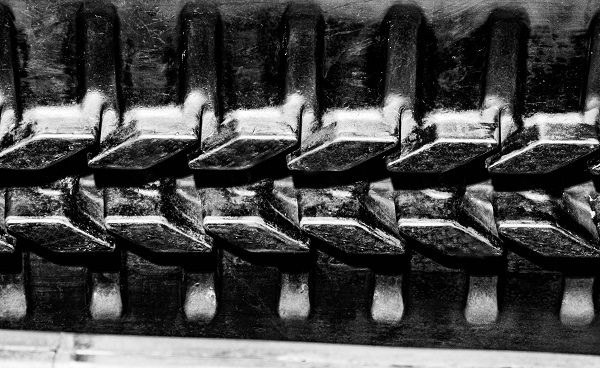
Photo: detail of ITR USCO's "diamond" technology in the rubber track
With anti-vibration rubber tracks you get
- greater operator comfort
- reduced wear
- lower maintenance costs
- improved machine stability
Comparative tests: conventional and anti-vibration rubber tracks
The excellent results obtained when using anti-vibration rubber tracks compared to standard rubber tracks are the result of practical field tests.
Video: comparative test on a mini excavator in the weight class up to 3.5 tonnes.